
When dairy producers think about improving profitability, they often focus on the cow.
But what if the biggest opportunity starts much earlier?
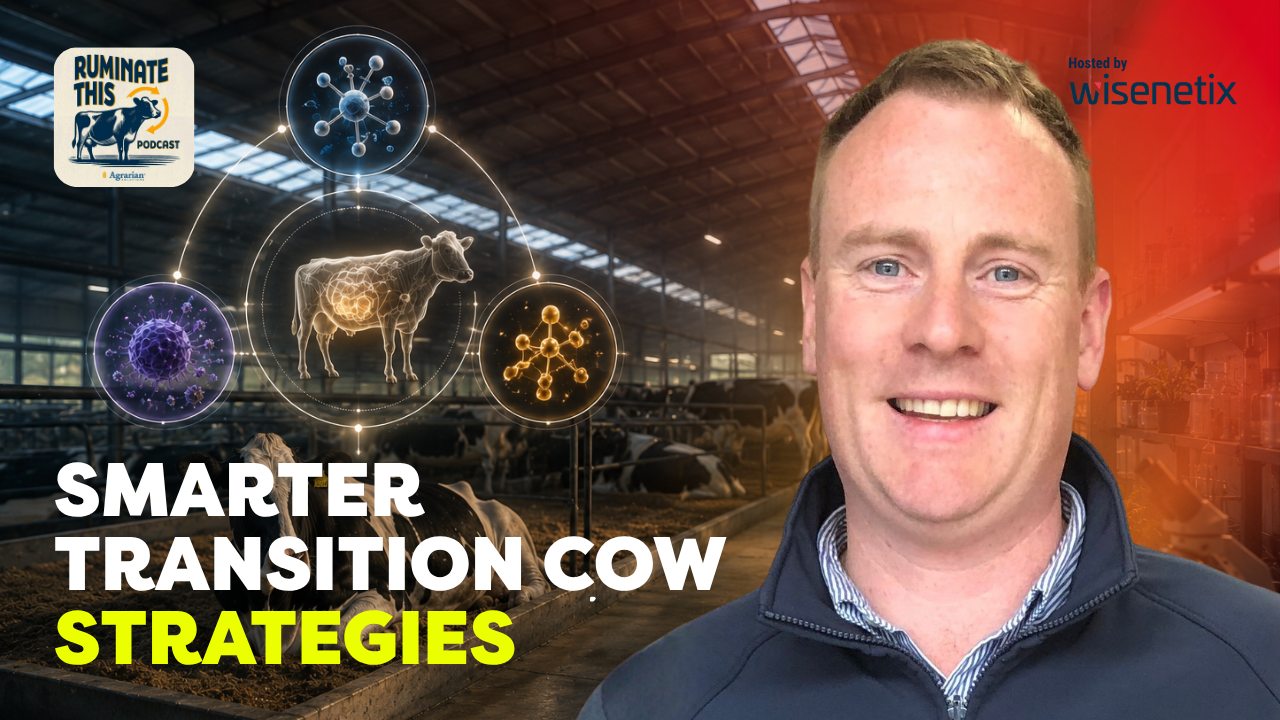
We’re excited to share this episode of The Dairy Podcast Show, where host Dr. Barry Bradford sits down with John Lawlor, dairy industry consultant, to discuss why forage quality, feed management, and system-wide thinking have a greater impact on profitability than many producers realize.
From harvest decisions to feed efficiency and long-term herd performance, this conversation explores how seemingly small management choices can influence milk production, feed costs, and overall business success.
In this episode:
- Why profitability begins before feed reaches the ration
- How forage quality drives feed efficiency
- The hidden costs of poor feed management
- Why system thinking improves dairy performance
- The importance of measuring what matters
- Common management decisions that quietly reduce profitability
- Building a more resilient dairy operation
- Practical ways to improve long-term return
💬 Have thoughts or a story to share? Email [email protected].
🎧 Listen now to set your herd up for lifelong success!
<div id=”buzzsprout-player-19575086″></div><script src=”https://www.buzzsprout.com/2324052/episodes/19575086-78-rethinking-transition-cow-health.js?container_id=buzzsprout-player-19575086&player=small” type=”text/javascript” charset=”utf-8″></script>
Barry Bradford: Hello. Welcome back to the Dairy podcast show, brought to you by Wisenetix. My name is Barry Bradford from Michigan State University. Today I’m happy to welcome to the show John Lawlor. John is the managing director of Anchor Life Sciences Limited. John, thanks a lot for being on the show today.
John Lawlor: Thanks, Barry. It’s an absolute pleasure to be chatting to you today. And we’ve done a lot of research in the past, and one of the big areas that kick started all was a lot of your research back in the day, looking at the the role of information and what it does and certainly think a little bit differently about transition cows and performance and to see, well, you know, is it all about calcium or something else at play.
And that really started the kind of ball rolling. And I think we’ve learned an awful lot more in terms of tradition, cows, maybe in the last 5 or 10 years that we have for a long, long time before. And there’s a lot more data research being done in this whole area. So another five years, ten years. We know a huge Whittemore.
Barry Bradford: Yeah. That’s exciting. Thank you. Let’s start a little bit with where you’re from, how you got to where you’re at. It doesn’t sound like you’re from Pennsylvania necessarily. No, no. Tell us about this space.
John Lawlor: This is a very strong Irish accent. So I, I grew up on a dairy farm just north of Dublin in Ireland. My local hometown is actually the hometown of Pierce Brosnan, who used to be James Bond back in the day. So we have a bit of a link. And so at home we milked about 350 cows on what we call a liquid build system.
So autumn calving and spring calving and trying to produce much grass as possible from far, and particularly grass if we can. And I suppose I went from the farming into business, so I started, I spent five years with Altec, the nutritional supplement company, and then started with a company called Celtic Sea Minerals. And they harvest a special type of seaweed called Lithuanian calcareoun up in Iceland.
And that business has a human health prior to the business. It has an animal health practice which is Calyx Minerals. And now we have Anchor Life Science, which is an animal veterinary product division. And between all of those, we have about 130 peer reviewed published papers on the role of that seaweed. So it’s very well studied, understood. I could do an awful, really fantastic things.
And when I saw some of the data of the beneficial role in terms of animal and human health, that’s where I suppose anchor kind of sprung from. How can we apply this type of seaweed into a range of health products? And that’s really where this was the product we have today: Cow Start Complete. It’s really kind of come from.
Barry Bradford: Very cool. Maybe we could take a minute and help us understand, like at least to people in the US, I think if you’re like, oh, I’m going to feed seaweed. Maybe people think of methane reduction or something, but like help us understand is, is it like dried and ground and what’s, what’s the logic of using a seaweed for cows?
John Lawlor: Yeah. So there’s three species of seaweed. There’s brown seaweed and green seaweed. Most people think of seaweed, they think of the stuff that washes up on the beach. And that generally is the brown seaweed. And the green seaweed. Very much a kind of a kind of a plant. And if we think about this bit like compared to making silage, you know, you let the grass grow, you cut it, you take it away and then it grows again.
You cut it. That’s the brown seaweed on the ground. So you’d have that kind of a life cycle. Okay. Our seaweed was a raid species and it has a very different life cycle. So it grows down to a depth of 15m because it needs sunlight for photosynthesis. And it grows really, really slowly. And what it does is over a long time, it absorbs 74 different minerals from the seawater, and it embeds them in a very unique plant matrix.
And then over time, as it matures, it gets carried away in the current to a an area of dead material. So we only harvest for the dead materials. We never got here, the live plants, we need them to keep producing and growing. We just have us over the dead material. So as a comparison, I would say that the red seaweed is more like an apple orchard.
You have the trees, they grow a crop of apples, they fall down. We take those apples away, but we leave the trees to keep growing apples every year.
Barry Bradford: Yeah, I like that. Okay. That’s cool.
John Lawlor: Yeah. So as a product is very it’s purely a mineral product except a 74 different minerals. But what makes it unique is that because our plant structure they’re very bioavailable in the human and in the cow very different. So say if you say main captive source might be limestone a rock source, it’s not nearly as bio available. Whereas the calcium and our product is completely bio available.
Barry Bradford: Kind of like what we talk about with like milk complex calcium versus a supplement like for humans. Same idea. Yeah. That’s cool.
John Lawlor: Exactly.
Barry Bradford: Okay. Well, I know your anchor is focused on transition cows, so maybe we could start off with you work across different systems, you know, kind of work with people around the world. What do you see kind of as big trends in terms of managing transition cows? Are we making progress on reducing disease incidents and that sort of thing?
John Lawlor: Yeah, I think it’s fascinating. In the last month I’ve been to South Africa. I’ve been to Holland, Ireland as well. We do a lot in New Zealand as well, and I think it really depends on the region you’re in. Some countries are at the cutting edge, like America, in terms of using native decade diets as much as possible and then supplementing cows at the point of calving to try and improve performance.
And other countries are really far behind where really what they’re trying to tackle is clinical milk fever. Okay? They’re just the cow that’s gone down. They get up, they get a going, and they think that that’s what they can do to solve it. But the one trend that really is growing everywhere is the use of oral calcium supplements, the ability to pick and choose higher risk cows and target a kind of a treatment program on them to try and reduce the risk of those issues.
And that is growing very strongly, the US being probably a more mature market, but certainly in Ireland we’re probably 5 or 6 years behind the US. Other markets could be 5 or 6 years behind us. But the one thing that’s really clicking into gear comprehensively everywhere is the picking a choosing of cows and supplementing to try and reduce the risk, because there’s no bigger problem or pain in the backside than a cow It goes down and then trying to trade or lifter and get it going, and there’s a good chance you’ll end up never really coming to anything anyway. So it’s just something to be avoided at all costs.
Barry Bradford: Yeah, yeah. Good point. And maybe a lot of our listeners, I mean, we have listeners from all different systems, but maybe you could help us understand a little bit better. What what are the biggest pain points for pasture based systems versus TMR based systems? Do they differ very much or not really?
John Lawlor: Yeah, I suppose very, very different and very the same at the at the same time. So pasture based systems were typically if cows are out on grass during the dry period, it’s a complete recipe for milk fever.
Barry Bradford: Yeah it is. Yeah.
John Lawlor: Absolutely. Absolutely. We see that in South Africa. We see it in New Zealand or we see it in Ireland. And our biggest challenge, I would say on the European side is we have a strict ban on the spreading of slurry during the winter. Yeah. So generally what happens is you make your first cut silage a really good stuff that goes to your milking cows, your higher ceiling, and then you put as much story out as you can on the second, third quarter.
And it’s low and you can, you know, you’re just restricted. And on every grazing system it just plays havoc. So certainly in Ireland, UK, lots of countries, the main cause of fever is not calcium, it’s potassium. Absolutely too much potassium locks up your magnesium. You can’t get the calcium going. Well you need to. So that’s the biggest challenge I think in other systems like in North America, you know, the forest, the diet you have can be quite high in calcium.
So you could be dealing in a, you know, a .8.8 5% calcium in the background in Ireland is probably 0.6, 0.55. So you have to tackle calcium and also potassium levels in the diet source. It’s very much the potassium managing grazing after that for the for the factors are different. The challenges are still the same. When cows are calving in the amount of time it takes to try and avoid the issue, and the cost of that issue are the same number of what part of the world you’re in. It costs exactly the same on that goes down. And obviously the sub tentacle cow is the biggest cost of all. It’s 80% of all of the costs of the subclinical cow.
Barry Bradford: Yeah okay. Help us then. You made a point that I’m not sure I would have seen from my vantage point that you said, you know, we see increasing adoption of oral calcium bolus is at or shortly post calving. What’s your read on I guess the research literature on that lately. What’s the takeaway points?
John Lawlor: Really interesting. There was a paper you’re from my alias. It was published a couple of years ago, and they did a meta analysis of 22 peer reviewed published papers on the use of oral calcium products and essentially what they were doing and what they weren’t doing. And I think traditional thinking is if we can keep that cow on our feet on the day after calving we’ve done everything we can do what you love a great lactation going forward, it’d be very productive and reproductive.
And this paper really said actually the data doesn’t support that viewpoint. So what it did find is in the day after calving in terms of clinical milk fever cases and retained the use of oral calcium products, did reduce the risk of those two diseases. But when you go to four days in milk fever, no effect, where you go to three weeks looking at urine infections displays amazing and ketosis no effect.
When you go to 100 days, you look at energy status in terms of body condition scoring. You look at milk production, you look at fertility, no effect. So I think it does a certain amount, but it may not just do everything we think it’s going to do.
Barry Bradford: Interesting. And how do you think that intersects with the concepts of the transient, hypocalcemia and persistent? Are you familiar with those ideas?
John Lawlor: Yes. Yes. We use that research from Jesse McCartney and Cornell in the development of of our product. And it’s interesting. Some of our data would support it, and some of our data would say, well, we get the calcium levels quite high in those calcium first four days. They produce more milk than any other group of cows, the ones that go down and back up, but the ones that go down completely.
So I think we need more data, more data points to see exactly. And I think if you look at the latest research from Cornell, you know, where they looked. The initial paper was looking at the transient cows and the delayed cows and the four different groups, and then they looked at the calcium level as being the kind of driver of cattle was low on day one, but okay.
Or day four or then that was perfectly fine. And I know they reviewed and actually looked in terms of inflammation markers of all of those cows to see what’s happening. And they’ve also seen a link certainly in one of those groups, it was inflammation. That was also a key factor in that. So I think this whole area, like I said, where you started all those years ago, looking information has a much bigger role to play, and our data would support that.
In terms of what we’ve seen, we certainly see that there’s more than calcium at play here. If we want to get the best performance out of transition cows, we need to look beyond just putting it to those cows because like that, that review of 22 papers, the effect is actually reasonably limited. And up to day one, there’s an effect what we want to get a successful transition cow period.
We’re not just thinking about day one. We’re thinking about the following days. We’re taking about production of fertility, fewer issues, fewer vet calls, that successful transition management. And if we want to achieve that uncertainty our data would support, we need to think a bit more than just calcium in these cows.
Barry Bradford: Okay, that makes sense. So yeah, like you said, that’s like one of the biggest headaches for a farm is down cows with milk fever. No. Yeah. Nobody likes that. It’s a headache that you feel horrible for the cow. But let’s say, you know, we we have strategies are hard to implement in some systems, but we have strategies that are pretty good at reducing that. Right? But we still don’t have great performance from all of our cows. So you said we got to look beyond calcium. So what do you what do you think about then? What’s the next things you’re looking at?
John Lawlor: Yeah. So I suppose when we were looking to develop the product first we kind of had the philosophy, you know, cows of three problems at calving. Calcium is only one of them. But immune function and energy status of two of them massively challenges those cows face. So I suppose our logical as well, if we can tackle those three issues together, if we can reduce the level of issues in those first two weeks after calving, can we then go and see a better performance of good production of fertility?
So in our product we have our seaweed in there. So it is very, very high levels of completely bioavailable calcium and easement as well as 72 other minerals in there. We have and again like I said, potassium is a huge challenge in a lot of areas. Having that extra magnesium in there is a huge benefit, but not usually available in most oral calcium products.
We also have some vitamin D3 in there. But we have to remember that our seaweed is proven in humans and in cattle to have a very strong, natural and potent anti-inflammatory effect. So we have the ideal ingredient in terms of we have something of a lot of calcium, magnesium, but it also acts as a very potent anti-inflammatory. And if you look at the latest work from Lance Baumgart where he’s saying, well, actually information is the first thing that happens, and then the drop in blood calcium levels is a consequence of the inflammation.
We used to think of this slide of this gateway disease idea, this gateway calcium drops and then all the problems happen afterwards. Whereas Lance is kind of saying, well, actually information happens for us. One of the side effects of that is the calcium dropping. But you have all the other issues in terms of energy, data production and other.
But the calcium dropping is side-effectively. It’s not the main event that starts. Everything that we used to think was and I think again, our data would, would show that when we have our, our product in there with that anti-inflammatory effect, when we compared to products that just put calcium in there, we get a very different range of performance across the lactation.
Barry Bradford: That’s interesting. Maybe you don’t know, but I’m curious, like the way you’re talking about this, it’s like a plant complex set of many minerals. So I’m sitting here thinking, okay, you see anti-inflammatory effects in multiple species. Do you have any idea what might drive that response with this product?
John Lawlor: Yeah, we’ve done a nice bit of research. So in cows we’ve seen in terms of induced acidosis, induced heat stress and in transition cows lowering of those markers of inflammation. We’re also just seeing a more detailed research. You know when there is an inflammation response, when that cow has an infection as an inflammatory response, we do want the cow to have some level of information because that is that response is a natural thing.
So we generally have a kind of a 12 hour quick response. And then you have a chronic response, which is for 12 hours afterwards. So what we’ve seen with our seaweed is it does not affect the natural first response of the body, but after that the chronic response, it has a very potent role to reduce the level that ongoing inflammation, which is the thing when we start rolling into one week, into two weeks, into three weeks, if if you’re that inflammation going, it’s holding back the performance of those cows.
So it’s good because if we had something that knocked inflammation right off the bat, that would be not an optimal scenario for the cow, because you’re just switching off our natural ability to tackle an infection. So we know that we can have, lead the code to do our natural thing to get that thing under control. And then we help from that 12 hour point afterwards to try and reduce the challenge on those cows.
And we look at body temperatures. Interestingly, we could see that we see an increase in the first 12, 18 hours after calving as that natural response kicked in. But from that point all the way to two weeks after calving, that the cows getting our product have lower body temperatures compared to the control groups. So there is, there’s definitely an effect there that is happening.
And we know that if you get a high, a rise in body temperature, it a is a huge challenge for the cow, but also takes a lot of energy for the immune system to fight that high level of inflammation, the high level of temperature. And at the time when every ounce of dry matter is really critical to really t this cow up, we don’t really want to be shipping 1 or 2 kilos of that to fight at the temperature effect.
Barry Bradford: Yeah. That’s fair. So yeah, you’ve referred to some important insights from your research. Maybe you could talk us through 1 or 2 of the studies you’ve conducted with, with this product.
John Lawlor: Yeah. I suppose the most interesting one is it’s a very large herd. And in the year 2024 on the main farm, they camped in 2035 second lactation and all the cows and all that, they had five cases of milk fever. So using an egg had died, but absolutely exemplary in terms of managing cows and calcium status. And no matter where you go in the world, you know, a quarter of a percent of cows having attended a case is as good as you will get.
So we knew when we started the work there that, you know, we’re going to get it was going to be a tough challenge to match what those cows are doing, but it was absolutely exemplary. So in the trial, we had group getting the standard treatment and then getting our two Cow Star Complete bonuses are calving. And when we looked at blood clotting status, it was exactly the same.
Numerically, we were a little bit ahead, but from a statistical point of view, there was no difference. And that’s interesting because that shows that those cows were ISO calcium. So if we saw any difference in performance after that, it was nothing to do with calcium because they were all exactly the same in terms of calcium. We also saw in terms of rumination levels, and we know rumination and calcium status are completely correlated.
But the rumination levels in those two groups was exactly the same as well. But we look at the levels of metabolic issues. So we look at in terms of, So there were no clinical cases in either book, which we expected. You look at your cases of retained the center, you look at the center. Traders displays are made some ketosis.
The cows and our group had lower results of metabolic issues in those first three weeks after calving. Really where we see the big difference when we look at body condition scoring, we can see and this is 147 cows per group. We can see that we have a statistically significant higher body conditions for every two weeks to 12 weeks into the lactation.
So despite the calcium being exactly the same and the rumination being exactly same, the energy status was notably different. We then saw in terms of those cows 2.6 kilo. So it’s going to be 5.3, 5.5 pounds of milk increase in milk production per day across the first 12 weeks. Imitation. That control group were at about 100 pounds of milk, so there were no slouches.
They were really, really top performers, but we still managed to increase the milk production on those cows across that time period. And again, when we look at fertility in that group, the conception rate for service was 49%, which for that level of performance and production, these are 29,000 pound cows is really good. Again, no slouches, whereas we started the group at 63%.
So a massive improvement of performance. So we’ve seen reduced levels of retained placenta and uterine infections and better body condition scores. And we know that those are two key drivers of better fertility in cows. And that data is very consistent. We do that on grazing cows and very high yielding cows. We get a very, very similar profile of terms of that increase in milk production and the increase in fertility and better body condition scores.
And if we go back to that research paper from the 22 studies they showed when we put oral calcium just straight oral calcium into those cows, no effect of body condition scores, no effect on milk production and no effect of fertility. Whereas we take Cow Star Complete, we’ve taken a wider range approach to tackling a wider range of issues. We do see a benefit across the board that you don’t get with other oral calcium products.
Barry Bradford: That’s fascinating.
John Lawlor: And there was another, there’s another research group who are doing a lot around this whole idea of getting the calcium consistently up to 48 and 96 hours after calving, but very much focused on the calcium side of the equation and getting the calcium perfect.
And in that way they have got the calcium perfect. But certainly from the the available public, publicly available data on that research group, they’re not having an impact in terms of energy status, in terms of glucose, in terms of BSB, in terms of body condition score, and not seeing an effect in terms of production either. So I think, again, when we look purely at the calcium side, we don’t shift the needle in terms of stuff that’s actually going to pay the farmer return on investment in terms of more milk production and better fertility as well.
Barry Bradford: Very interesting. So I think you talked about a little bit, but this is a bolus that you give one time. Like what’s your target window. Is that right?
John Lawlor: Yeah. Exactly. Exactly. So one of the big things we tried took us seven years to perfect the technology, what it is to be able to give one dose to the calcium, one doses, two boluses at the point of calving, and it will elevate the blood calcium all the way to 48 hours and all the way to 96 hours in those cows.
And that’s really important because, statistically speaking, the highest risk period for milk fever is between 12 and 24 hours after calving. So it’s not the first 12 hours, it’s the second 12 hours. Most traditional oral calcium products masked for what they claim 12 hours, but it may only be 8 to 10 hours. So when you put the first one in all those manufacturers, if you look at the label, recommend that the farmers give a second dose 12 hours after calving so that when the first one is out, is out of the system, you give an extra hit of calcium for these girls has of just entering into a higher risk period, whereas the concept we have is much more simple. It’s just one handling of the cow.
The two boluses is going to go on at the same time, but once she’s done, she’s okay for 48 hours and at that point they can start increasing their own supply of calcium. So it’s very much in terms of convenience, in terms of farms that may not have a lot of labor available, but they may not a very good handling and drafting facilities. So catching that the second time can be too much of an effort in a job and it just doesn’t get done. This just simplifies that.
Barry Bradford: Yeah. Well, and I was going to say too. I think I’ve seen a lot of farms thinking more about the stress implications of locking up the fresh pen every day. And that’s really declined in the US, I think. So having a strategy that you could take care of this in the fresh pen and then in theory, if she’s healthy, you’re not locking her up again.
John Lawlor: Exactly.
Barry Bradford: As has some real advantages. Interesting.
John Lawlor: And I think one of the real advantages in reality is, you know, the first time you go and you get the gun and you bolus that cow, you know, that’s okay. When she sees you coming for the second time with the gun in hand, she knows what you’re about. And they generally tend to be very uncooperative. So it can be a really tough job to do.
Barry Bradford: Yeah I agree with that. Okay. Well we’ve got our famous questions we’ve got to throw at you. So first of all, what’s what’s your favorite dairy related book or resource?
John Lawlor: As you might have guessed, I like people who think outside the box and who just won’t accept, you know, the standard protocol and say, well, can we not do things better? And I think as dairy farmers spend a lot of money asking and talking to people like the accountant, like the vet, like the nutritionist, but there’s one team out there that can tell those farmers an awful lot out there, and it’s the cows themselves.
If you can only learn how to read what that cow wants to tell you, because if every cow is at all times telling you something about the environment she’s in. So there are two guys in Holland who developed this system called cow signals. So I’m not sure if it’s very popular in the US or some people know or not.
But yeah, yeah, yeah, it’s a fantastic way of thinking about things. And if you could just learn to read what that cow is telling you, it can tell you so many things and you can make some small, what you might think are small changes, but could be big changes for the cow. And you can make a lot of improvements quite quickly.
If you could just learn how to read what that cow is telling you. It’s very simple, but it can be very, very powerful and effective. And I think in terms of a dairy related resource, that to me is one of the best ones out there.
Barry Bradford: Yeah, I don’t think any major brought that up on this show that I’ve heard. That’s great. That’s a good point. I’m familiar with that program. Very good. All right. What about your favorite book or resource outside of agriculture?
John Lawlor: Okay. This one is a special one to be. So this is a book called Race Without End. So this was published in 1994 and I actually had a signed copy. So back in the 80s and the early to mid 90s in Ireland, Ireland was a very poor country. We were bottom of the league in terms of economic development and everything, and this guy called Eddie Jordan set up a Formula One team and he became massively successful with that former team.
He was a really great entrepreneur. He won the Irish Entrepreneur of the year competition, but he had an Irish team fighting at the pinnacle of the biggest sport in the world. And just in terms of inspiration, when you’re looking and nothing is going right in your country and you can say, well, actually people from Ireland can do the best of the best and fight up with Ferrari and with Williams and McLaren and all these big guys.
And he was a hell of a story. That team now is the Aston Martin formula one team. That team is worth billions today. But it started one Irish guy who was plucky enough to just give it a go and see how far he could take it.
Barry Bradford: Wow. I hadn’t heard of that story. That sounds awesome. And then that was kind of right when the what? The Irish tiger economy took off.
John Lawlor: The mid 90s. Yeah. Yeah, yeah. Really started to take off. And we grew up a lot and everything developed. So we’re very much at the top end of the scale running the bottom. But but you’re in a place where you look around and everything is dreary and unemployment is 30% and there’s no real kind of hope and you can see something like this happen.
I know he’s inspired a lot of Irish people to kind of go, you know, we can do these things. We can fight on the global stage and a really interesting, unfortunately, we lost Eddie Jordan last year. He died. But he left a big legacy in sport and in business in Ireland.
Barry Bradford: Okay. Last question. In your opinion, what sets successful dairy professionals apart from those who are less successful?
John Lawlor: If I could distill down to one thing? Honesty. Being brutally honest, I find and I would go to a lot of dairy farms and I have a discussion with them and the guys that are really open and say, look, these are the problems I have. You can make a lot of progress with those guys, and sometimes a lot of times, what we might find as being a solution has nothing to do with us as not to do.
Bolus isn’t like that. There could be something else, but if you could just find a guy that’s really honest, you can make real progress. And I think sometimes you go to farm and the farmers telling you I’m here, or you walk around the cows and you see the farm and maybe they’re here, but they might be down there, you know.
So but you get out and you see, you get a really good appreciation for where they’re at. But the guys that are completely honest, if the farm is here, they’re, they’re they’re not up here, they’re here are sometimes a little bit down here. They’ll be humble. But the guys that can be really honest and say, look, these are the challenges.
This is what it’s been we’ve been struggling with for the last few years. And we really want to focus on improving this part of the business. They can make real progress. The guys who just don’t think it’s a problem or don’t address it, or just a bit embarrassed or they don’t want to admit it, you know, they just keep muddling on and not making progress.
Barry Bradford: I like that a lot. It brings back to mind to me a very short list of key traits of a good leader. And one of them was deal in reality. Like, you know, you can, you can pump people up, you can try to support them. But we have to face the real issues we have with honesty, like you said. That’s good. Yeah. Well, John, I very much enjoyed the conversation. Thanks for being on the show today.
John Lawlor: It’s been an absolute pleasure. Barry. Thank you very much for having me.
Barry Bradford: So again, our guest today has been John Lawlor from Anchor Life Sciences. And this has been another episode of the Dairy podcast show, brought to you by Wisenetix. If you’re not already following the show or you haven’t liked it, make sure you do that so you don’t miss the next episode, and we’ll see you then.

