The early-lactation period sets the stage for success or failure throughout the rest of lactation. Cows that eat more and make more milk in the first 30 days after calving have higher peaks and make more milk over the lactation¹. Getting fresh dairy cows off to a good start is essential for a productive herd. Management, environment, and feed hygiene are major factors that contribute to the cow’s ability to transition well. Mycotoxins depress feed intake, resulting in fewer nutrients for milk production and an inflammatory load. The liver must remain healthy to eliminate toxins, support the immune system, and make the glucose the cow needs to produce milk. Defending the digestive tract from mycotoxins and protecting liver health are essential factors to enabling the cow to eat more and to make more milk.
DTX™ is research-proven to protect against mycotoxin-related inflammation, leading to increased milk yield and improved reproductive performance in dairy cows²,³. Plant phytogenic technology has moved beyond traditional herbal medicine to plant molecules with specific effects in the digestive tract and liver. This study evaluated the combined effects of Agrarian Solutions’ proprietary bacteria technology and plant molecule blend in lactating Holstein cows fed a diet with a moderate risk of mycotoxin contamination.
Methods
Sixteen multiparous Holstein cows on a commercial research farm were blocked by calving date, lactation (average 3.38), previous 305-day milk yield (average 35,931 lbs), and average test-day SCC (average 42,000) and randomly assigned to one of two treatments. Treatments were 14 g per cow per day of Select DTX⁴ top-dressed in 100 g of soybean meal (DTX) or a control treatment of a top-dress of 100 g of soybean meal (CON). Treatments were fed once daily from the day of calving through 91 days-in-milk. Cows were housed in one free stall pen and fed ad libitum in BioControl® feed tubs. The TMR was sampled biweekly and analyzed for mycotoxins at Dairyland Laboratories. Cows were milked three times daily, and milk was sampled one day weekly from three consecutive milkings for yield, components, and milk fatty acid analysis. Two trained individuals recorded BCS on d 1, 45, and 90 after calving, and body weight was measured after each milking.
Mycotoxin Contamination
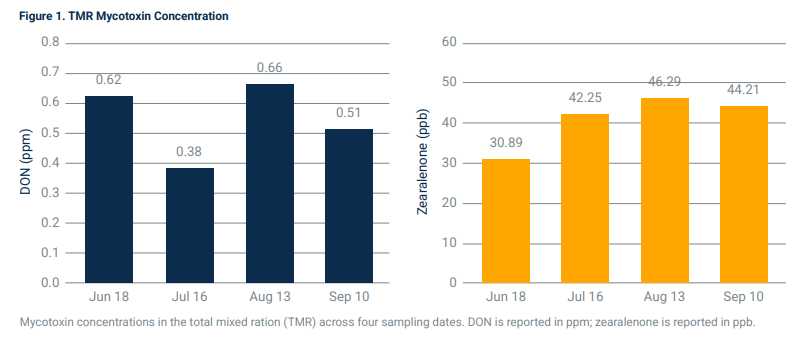
The mycotoxin contamination of the TMR is presented in Figure 1 and averaged 0.54 ppm DON and 41 ppb zearalenone, which are considered to pose medium- and low-risk levels, respectively.
Results
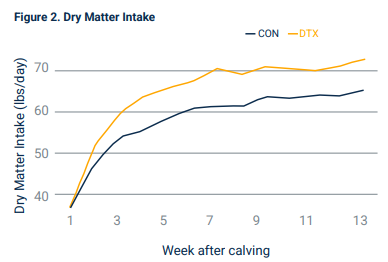
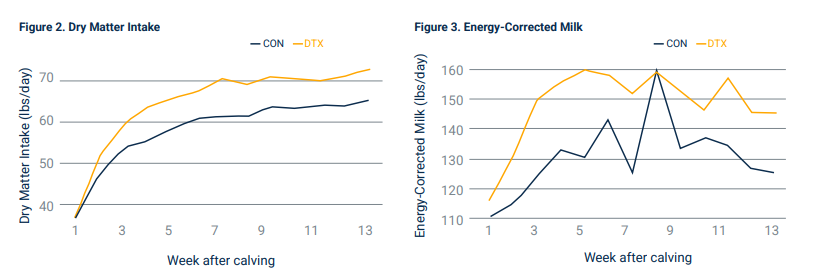
There were no differences in body weight (average 1,470 lbs) or body condition score (average 3.40) between the treatment groups throughout the experimental period. Daily dry matter intake was significantly increased 6.4 lbs per day by feeding DTX compared to the control group (64.6 lbs vs 58.2 lbs, P = 0.04, Figure 2). Mycotoxins alter ruminal bacteria and damage cells lining the digestive tract, potentially decreasing feed intake.
Enhancing gut integrity and protecting against mycotoxin damage allowed the DTX cows to quickly increase feed intake after calving.
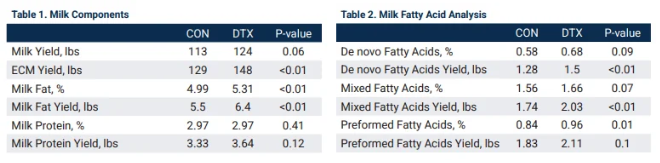
Milk yield and component data are presented in Table 1. While test date milk yield was not significantly different, there was a numerical increase of 11 lbs for cows fed DTX (124 lbs vs 113 lbs, P>0.05). Milk fat percentage was greater for DTX-fed cows (5.31% vs 4.99%, P<0.01), which contributed to higher fat yield (6.4 lbs vs 5.5 lbs, P<0.01) and higher ECM yield of 148 lbs vs 129 lbs (P<0.01, Figure 3). Milk protein percentage was not different between treatments. Milk fatty acids were analyzed at each test date and showed a similar significant increase for cows fed DTX (P<0.01, Table 2).
Energy-corrected milk yield and milk fat yield likely increased in DTX-fed cows due to increased feed intake and proper nutrient allocation due to resolving mycotoxin- and other dietary-related inflammation. There were no differences in BCS or body weight throughout the treatment, and DTX-fed cows also had greater de novo and mixed fatty acids. An increase in de novo and mixed fatty acid groups indicates the increased milk fat production in cows fed DTX resulted from diet and intake. De novo fatty acids derive from ruminal fermentation and the diet, while preformed fatty acids come from body fat mobilization or diet-suppliedC:18 fatty acids, and the mixed fatty acid group comes from a mixture of the two other groups⁵. Because all three fatty acid groups were increased similarly, and BCS and body weight were the same between treatments, increased dietary intake of feed and fatty acids, as well as nutrient reallocation, were the main contributing factors towards higher milk fat, not simply mobilizing body fat.
Conclusions
By protecting against mycotoxins and defending the liver during the critical early-lactation period, cows fed DTX increased feed intake more rapidly. Feeding DTX helped defend and protect from mycotoxin related inflammation and potentially other diet-related inflammation during the vulnerable post-calving period, enabling fresh cows fed DTX to eat more and reallocate nutrients to make more milk and components while maintaining body condition.
References:
¹Jorgensen, C. H., et. al. 2016. J Dairy Sci. 99:3241-3249.
²,³Roth, L. D., et al. 2024. J. Dairy Sci. 107(Suppl 1):426.
⁴14 g of Select DTX provides the same bacteria technology and phytogenics as 9 g DTX Concentrate.
⁵Barbano, D. M., et al. 2014. Proc. Cornell Nutrition Conf. 105-113.
Authors: Caroline Knoblock, MSc, – Director of Nutrition, Agrarian Solutions and Larry Roth, Ph.D., PAS – Vice President of Nutrition