First-service reproductive performance is closely linked to how well a cow recovers from the challenges of calving. Cows experiencing severe negative energy balance or uterine disorders are more likely to have less favorable reproductive outcomes than healthy cows. To transition successfully into lactation, cows must resolve calving-related inflammation and defend against pathogens that can cause infections of the uterus and mammary gland. At the same time, dietary changes and the associated stress on the digestive system can further challenge the cow. These combined stressors increase susceptibility to disease, requiring the cow to allocate more energy and nutrients to immune function at the expense of milk production and reproduction.
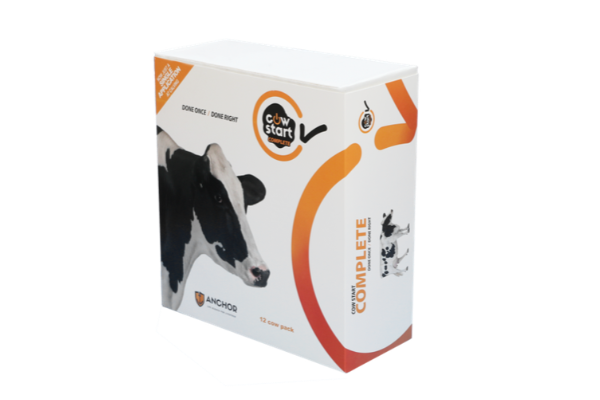
A well-supported immune system helps cows navigate the transition period and establish a successful lactation. Cow Start Complete supplies key trace minerals and antioxidants that support immune function in a convenient, single-application bolus program. Administered as two boluses together at calving to second- and greater-lactation cows, the product combines the mineral contribution of marine seaweed with a physical formulation designed to release nutrients over 48 hours. Along with vitamins D and E and selenium, this combination helps provide critical nutrients during the demanding transition period with just one application.
Multiple studies have evaluated Cow Start Complete for multiple-lactation cows against bolus supplementation or a calcium-only bolus. A meta-analysis combining reproductive data from 10 research studies and 761 multiparous cows found improved reproductive outcomes among cows receiving Cow Start Complete.
Days to first service did not differ among treatment groups; however, several subsequent reproductive measures favored Cow Start Complete (Table 1). Days to conception were significantly lower for cows receiving Cow Start Complete, at 84 days compared with 89 days for cows receiving no bolus and 91 days for cows receiving a calcium-only bolus (P < 0.05). Cows receiving Cow Start Complete also required fewer services per conception: 1.4 compared with 1.7 in both comparison groups (P < 0.001).
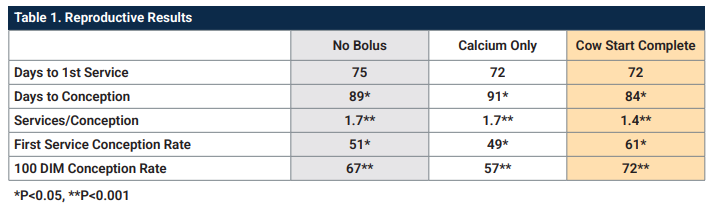
First-service conception rate was reported as 61% for cows receiving Cow Start Complete, compared with 51% for cows receiving no bolus and 49% for cows receiving a calcium-only bolus. The percentage of cows pregnant by 100 days in milk was also higher with Cow Start Complete, reaching 72% compared with 67% for no bolus and 57% for calcium only (P < 0.001).
On farms using Cow Start Complete, producers report healthier cows following calving and improved reproductive performance. Better reproductive outcomes can help cows conceive with fewer services and support greater efficiency and productivity over the course of lactation. These meta-analysis findings provide additional evidence supporting the use of Cow Start Complete with multiple-lactation cows as part of a comprehensive transition-cow management program.
Authors: Caroline Knoblock, MSc, – Director of Nutrition, Agrarian Solutions and Larry Roth, Ph.D., PAS – Vice President of Nutrition